Prediction markets went from obscure financial instruments to a $50 billion industry almost overnight[1]. Kalshi's valuation jumped from $2 billion to $5 billion in three months[2]. Polymarket became the go-to platform for election predictions. PrizePicks exploded in popularity for sports betting. But what exactly are prediction markets, how do they work, and should you actually use them in 2026?
This guide breaks down everything: the difference between Kalshi (CFTC-regulated financial markets) and PrizePicks (daily fantasy sports), how to use each platform, the legal landscape, strategies that actually work, and whether prediction markets are worth your money.
What Are Prediction Markets (And Why They Exploded in 2025)
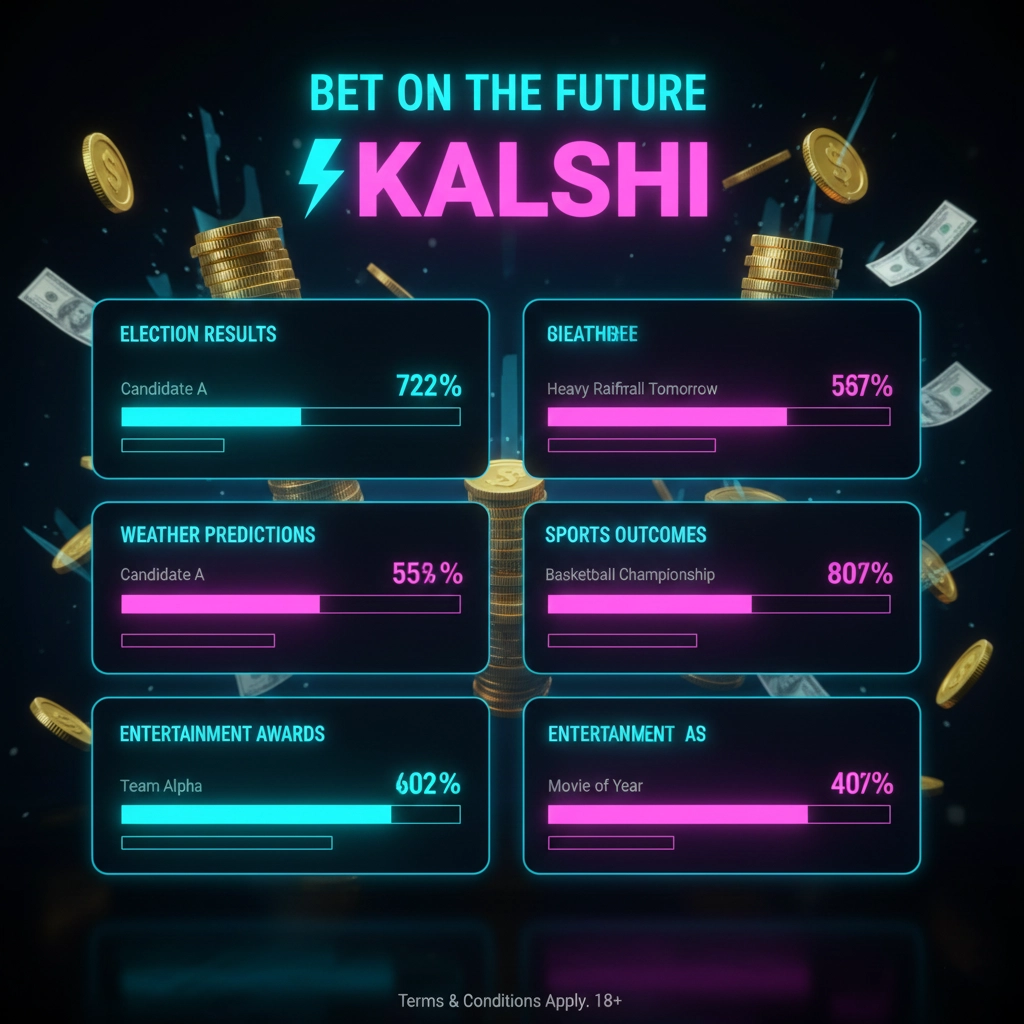
Prediction markets let you bet real money on the outcome of future events—elections, economic indicators, sports, tech company IPOs, even celebrity outcomes[3][4][5]. Instead of betting against a house or bookmaker, you trade contracts with other users in a marketplace[3][6].
How they work: If you think an event will happen, you buy a "Yes" contract. If it happens, the contract pays $1. If it doesn't, it pays $0. The market price reflects collective belief in the outcome[3][6][7].
Example: "Will it snow in New York on Christmas?" trades at $0.65. If you buy and it snows, you profit $0.35 per contract ($1 payout - $0.65 cost)[6]. If it doesn't snow, you lose your $0.65[6].
Why 2025 was explosive:
- Kalshi's trading volume jumped from $300M to $50B annualized[1][2]
- Sports betting integration made prediction markets mainstream[1][8]
- CFTC cleared legal path for political and sports contracts[9][10]
- Integration with Robinhood and Webull brought millions of new users[1]
- 60% global market share for Kalshi alone[1][2]
The shift: Prediction markets moved from academic research tools to legitimate financial instruments competing with DraftKings, FanDuel, and traditional sportsbooks[1][8].
Kalshi vs PrizePicks: The Key Differences
These are fundamentally different platforms serving different purposes, though both involve predicting outcomes[11][12].
Kalshi: CFTC-Regulated Event Contracts
What it is: Legal, regulated prediction market for trading event contracts[3][13]. Registered as a Designated Contract Market (DCM) with the CFTC[9][14].
What you can trade:
- Economic indicators (inflation, GDP, unemployment)[15]
- Political events (elections, legislation passing)[9][10]
- Sports outcomes (Super Bowl winner, playoff results)[1][8]
- Tech company IPOs (will OpenAI go public this year?)[16]
- Weather events (will it snow, hurricanes, temperature records)[6]
- Cultural events (Oscar winners, papal succession)[3]
How contracts work: Binary Yes/No contracts that settle at $1 (win) or $0 (lose)[3][6]. You buy/sell at market prices reflecting probability[6].
Profit mechanism: Buy low, sell high before expiration, or hold to settlement[6][15].
Regulatory status: Fully legal under CFTC oversight. No state sports betting license required (major legal battle ongoing)[9][10][17].
User base: 140+ countries, integrated with Robinhood/Webull[1][18].
PrizePicks: Daily Fantasy Sports Platform
What it is: Player prop fantasy sports platform where you pick 2-6 player stat projections[19][20].
How it works: Choose player stats (LeBron points, Mahomes passing yards), predict "More" or "Less" than projection, win if you're right[19][20][21].
Game modes:
- Power Play: All picks must hit. Higher payouts (up to 25x)[19][22]
- Flex Play: Can miss 1-2 picks and still win. Lower payouts but safer[19][22]
Sports covered: NFL, NBA, MLB, NHL, soccer, golf, UFC, esports[19][20].
Profit mechanism: Win your group (highest score) OR hit minimum guarantee payout if picks are correct[20][23].
Entry fees: $1 minimum, unlimited maximum[19][20].
Regulatory status: Operates as Daily Fantasy Sports (DFS), not traditional sports betting. Legal in 33+ states[24].
Side-by-Side Comparison
Kalshi: Financial trading platform. CFTC-regulated. Buy/sell contracts. Wide variety of non-sports events. Sophisticated traders. Binary outcomes[3][6][13].
PrizePicks: Fantasy sports platform. State DFS licensing. Pick player props. Sports only. Casual bettors. Parlay-style entries[19][20][22].
Bottom line: Kalshi = prediction market for trading real-world events. PrizePicks = fantasy sports for betting on player performance[3][19].
How to Use Kalshi: Step-by-Step Guide
Step 1: Create Account & Deposit
Sign up: Visit Kalshi.com, verify identity (KYC required)[13][25].
Deposit methods: Bank transfer, debit card, wire transfer[25]. Minimum $10[25].
Time: Verification takes 5-15 minutes[25].
Step 2: Browse Markets
Categories: Politics, economics, sports, tech, weather, entertainment, current events[3][15].
Example markets (real from 2025):
- "Will inflation be above 3% in December 2025?" - Yes: $0.72, No: $0.28[15]
- "Will Databricks IPO by year-end?" - Yes: $0.21, No: $0.79[16]
- "Will it snow 6+ inches in NYC on Christmas?" - Yes: $0.15, No: $0.85[6]
Step 3: Understand Pricing
Contract price = implied probability[6][7].
$0.72 price = market believes 72% chance event happens[6].
Your edge: If you believe true probability is higher than market price, buy Yes. If lower, buy No (or sell Yes if you hold it)[6][26].
Step 4: Place Your First Trade
Choose position: Buy Yes (you think it'll happen) or No (you think it won't)[6].
Enter quantity: Number of contracts (each settles at $1 if you win)[6].
Calculate risk/reward:
- Buy 100 Yes contracts at $0.65 = $65 cost[6]
- If event happens: Win $100 (100 contracts × $1) - $65 cost = $35 profit[6]
- If event doesn't happen: Lose $65[6]
Submit order: Market or limit orders available[25].
Step 5: Monitor & Exit
Hold to expiration: Let contracts settle at $1 (win) or $0 (lose)[6].
Exit early: Sell contracts before expiration if price moves in your favor[6][26].
Example: Buy Yes at $0.65. Price rises to $0.80 as event becomes more likely. Sell for $0.15 profit per contract before outcome is known[6][26].
How to Use PrizePicks: Step-by-Step Guide
Step 1: Sign Up & Deposit
Download app: iOS or Android. Web version available[19][20].
Create account: Email, age verification (21+ in most states, 18+ in some)[20][27].
Deposit: Debit card, PayPal, credit card[20]. Minimum $10[20].
Promo codes: "PrizePlay" for $50 bonus after first $5 lineup[28]. Various other codes available[19][28].
Step 2: Pick Your Players
Choose 2-6 player projections from any sport[19][20][21].
Example picks:
- LeBron James: 26.5 points (pick More or Less)[19]
- Patrick Mahomes: 285.5 passing yards (pick More or Less)[19]
- Jayson Tatum: 8.5 rebounds (pick More or Less)[19]
Mix sports: Can combine NFL, NBA, MLB in one lineup[19][20].
Step 3: Select Play Type
Power Play (higher risk, higher reward):
- All picks must hit[19][22]
- 2-pick: 3x payout[22]
- 3-pick: 5x payout[22]
- 4-pick: 10x payout[22]
- 5-pick: 20x payout[22]
- 6-pick: 25x payout[22]
Flex Play (lower risk, guaranteed payout):
- Can miss 1-2 picks and still win[19][22]
- Lower multipliers but higher win rate[22]
Step 4: Set Entry Amount & Submit
Choose stake: $1 minimum, unlimited maximum[19][20].
See potential payout: App shows exact winning amount before submission[20][23].
Example: $10 entry on 4-pick Power Play = $100 potential win (10x multiplier)[22].
Submit lineup: Locks in your picks[20].
Step 5: Track Performance
Real-time updates: Picks turn green (winning) or red (losing) as games progress[20][29].
Group matching: You're matched with other users of similar experience level[20][23].
Win conditions:
- Win your group (top score)[23]
- Hit minimum guarantee (all picks correct on Power Play, or flex criteria met)[20][23]
Strategies That Actually Work
Kalshi Strategy: Information Edge
1. Identify mispriced markets
Look for events where you have superior information vs the crowd[7][26][30].
Example: Weather markets. If you check NOAA data and forecast models show 85% snow probability but Kalshi price is $0.65, that's edge[6][30].
2. Arbitrage opportunities
Yes + No prices should equal $1. If Yes = $0.48 and No = $0.48, you can buy both for guaranteed profit[26][30].
3. Early positioning
Markets become more efficient closer to resolution. Early positioning when prices are less informed can yield edge[30][31].
4. Portfolio approach
Diversify across uncorrelated events. Don't bet entire bankroll on single market[26][30].
Research shows: Kalshi prices are accurate predictors, with accuracy increasing closer to market close[31]. However, favorite-longshot bias exists—favorites underperform expectations, longshots overperform[31].
PrizePicks Strategy: Sharp Line Shopping
1. Use EV calculators
Tools like OddsJam, DGFantasy compare PrizePicks lines to sportsbook odds[32][33][34].
Find +EV picks: When PrizePicks projection is softer than market consensus[32][33].
2. Target "Goblin lines"
Easy picks where projection is significantly off market[35]. These won't last long—PrizePicks adjusts quickly[35].
3. Correlation strategy
Combine positively correlated picks (QB passing yards + WR receiving yards from same team)[36]. If QB has big game, WR likely does too[36].
4. Avoid "Demon lines"
Picks with highest multipliers are usually trap bets[35]. PrizePicks makes these projections harder intentionally[35].
5. Bankroll management
Never risk more than 5-10% of bankroll on single slate[37]. Use Kelly Criterion for position sizing[37].
Reality check: PrizePicks is -EV long-term for most users. House edge exists. Only sharp bettors with statistical edge consistently profit[33][38].
The Legal Landscape (Current as of December 2025)
Federal Status
Kalshi & prediction markets: Regulated by CFTC as event contracts[9][14]. Dodd-Frank Act removed "economic purpose test," allowing non-commodity futures[14][39].
Key legal win: CFTC tried to ban political election contracts in 2024. District court sided with Kalshi. CFTC dropped appeal in May 2025[9][10]. Political and sports contracts now legal federally[9][10].
PrizePicks: Operates under Daily Fantasy Sports (DFS) exemption, not traditional sports betting[24].
State-Level Battles
Problem: States claim prediction markets violate sports betting laws by offering "untaxed gambling"[1][17][40].
States that issued cease-and-desist orders (as of Dec 2025): Maryland, Massachusetts, Nevada, Arizona, Arkansas, Connecticut[17][41][42].
Active lawsuits: Kalshi fighting multiple state bans[17][42]. Most cases pending in federal courts[17].
Court precedent: Nevada ruled against Crypto.com (prediction market operator)[17]. Other states cases ongoing[17][42].
Supreme Court likely: Legal experts predict Supreme Court will hear prediction market case by 2027-2028[43]. Federal vs state regulatory authority at stake[43].
PrizePicks availability: Legal in 33+ states. Check local regulations before depositing[24][27].
Risks & Downsides You Need to Know
Regulatory uncertainty: States can ban platforms overnight[17][42]. Money could be frozen during legal battles[42].
Platform risk: Kalshi/PrizePicks hold your funds. Not FDIC-insured[44]. If platform fails, recovery uncertain[44].
Addiction potential: Prediction markets trigger same dopamine response as gambling[45]. Easy to overtrade[45].
House edge (PrizePicks): Rake and built-in margins make long-term profitability difficult for average users[33][38].
Market manipulation (Kalshi): Low-liquidity markets vulnerable to price manipulation[26][30].
Tax complexity: Event contract gains taxed differently than sports betting winnings. Consult tax professional[46].
Information asymmetry: Sophisticated traders with better data/models have edge over casual users[30][31].
Common Questions About Prediction Markets
Q: Are prediction markets gambling?
A: Legally, no—Kalshi is regulated as derivatives trading[9][14]. Functionally, yes—you're risking money on uncertain outcomes[40]. States disagree on classification[17][40].
Q: Can I make consistent money on Kalshi or PrizePicks?
A: Possible but difficult. Requires informational edge, disciplined bankroll management, and statistical sophistication[30][31][33]. Most users lose money long-term[38].
Q: What happens if my state bans these platforms?
A: Funds should be withdrawable, but legal battles could delay access[42]. Read platform terms carefully[44].
Q: How are winnings taxed?
A: Kalshi: likely capital gains. PrizePicks: gambling winnings. Both reportable to IRS[46]. Consult tax professional for specifics[46].
Q: Which platform should I use?
A: Kalshi for non-sports events, trading real-world outcomes, diverse markets. PrizePicks for sports player props, parlay-style betting[3][19].
The Verdict: Should You Use Prediction Markets in 2026?
The industry is real and growing: $50B annualized volume[1], $5B valuations[2], integration with mainstream brokerages[1]. Prediction markets transitioned from niche to mainstream in 2025[1][2].
Kalshi advantages: Diverse markets beyond sports[3][15]. Ability to trade complex real-world events[6][16]. CFTC regulation provides legitimacy[9][13]. Exit positions early (don't need to hold to expiration)[6][26].
Kalshi downsides: State legal uncertainty[17][42]. Information edge required for profitability[30][31]. Limited liquidity in some markets[26].
PrizePicks advantages: Simple, accessible sports betting alternative[19][20]. Parlay-style excitement[22]. Legal in more states than traditional sportsbooks[24].
PrizePicks downsides: House edge makes long-term profit difficult[33][38]. Limited to sports only[19]. High addiction potential[45].
Who should try Kalshi: If you have informational edge in specific domains (weather, economics, politics), disciplined risk management, and interest in trading non-sports events[6][15][30].
Who should try PrizePicks: If you enjoy sports betting, understand player props, and treat it as entertainment with money you can afford to lose[19][37].
Who should avoid both: If you're prone to gambling addiction, lack discipline, or expect easy profits[37][38][45].
The bottom line: Prediction markets are financial instruments, not get-rich-quick schemes. They work for informed, disciplined traders with edge. For everyone else, they're entertainment that will likely cost you money long-term[30][31][38].
The house always has an edge. The question is whether your information edge exceeds it[30][31][33].