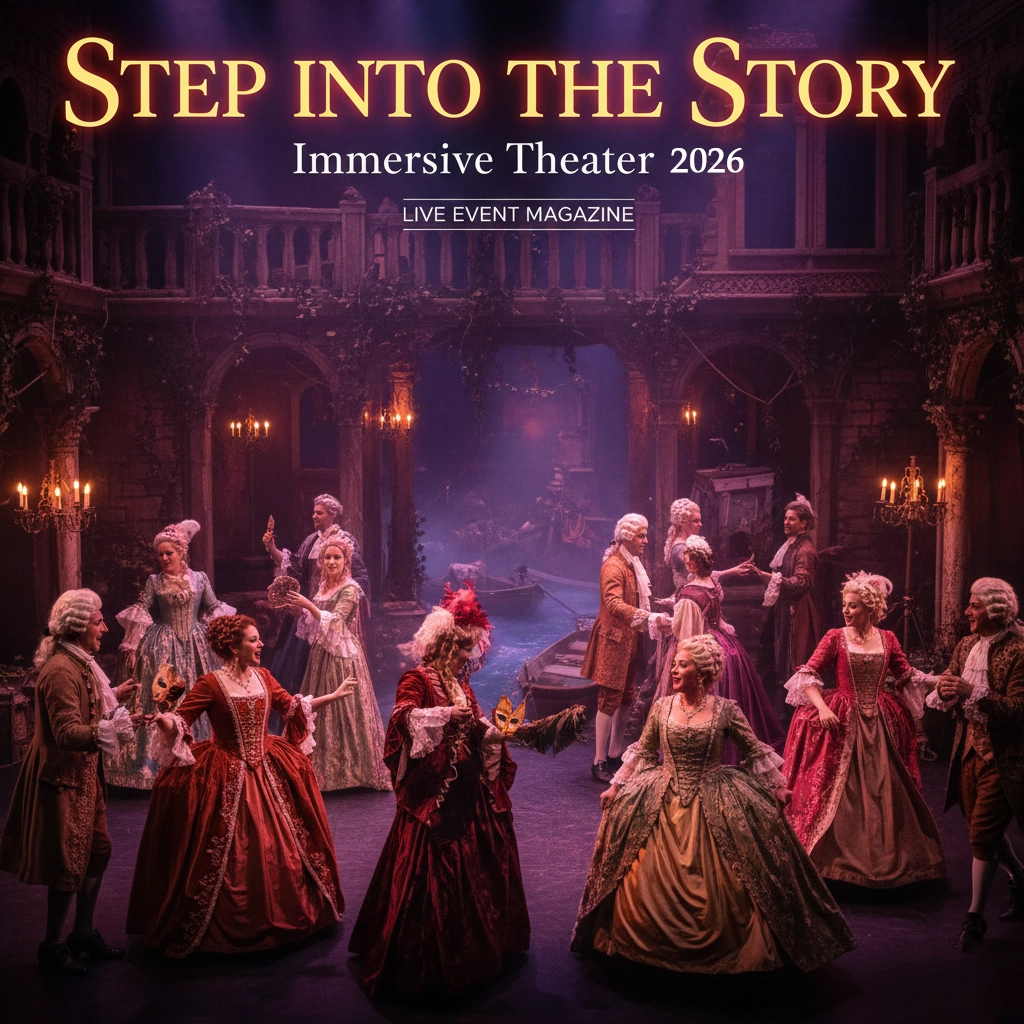
Traditional theater asks you to sit quietly in the dark and watch from a distance. Immersive theater makes you part of the story, an active participant in a living narrative. And in 2026, this explosive industry is projected to hit $2.1 trillion—18 times larger than it was in 2024[1][2]. Sleep No More, The Great Gatsby Immersive, and Van Gogh Experiences aren't outliers anymore. They're the blueprint for how entertainment will work from now on[3][4][5].
This comprehensive guide breaks down what immersive theater actually is, why it's exploding now with 400% growth in a single year, the specific technologies driving innovation (XR, AI lighting, virtual production), which experiences are genuinely worth your money in 2026, realistic ticket pricing strategies, how to choose the right experience for your preferences and comfort level, and why this fundamental shift from passive to participatory entertainment is permanent and irreversible[1][6][7].
What Is Immersive Theater (And Why It's Exploding in 2026)
Immersive theater removes the "fourth wall" between performers and audience in ways traditional theater never attempted[8][9]. Instead of watching from seats, you move through environments, interact with actors, make choices that influence the narrative, and become an active participant rather than passive observer[8][10][11]. You're not watching a story—you're living inside one[8].
The market explosion is undeniable and unprecedented in entertainment history:
- 2024: $117.33 billion immersive entertainment market[2]
- 2025: $493.5 billion (4.2x growth in single year)[1][2]
- 2034 projection: $2.1 trillion at 18.04% compound annual growth rate[1][2]
This isn't modest growth. This is exponential expansion signaling fundamental industry transformation[1][2]. To put this in perspective, this growth rate surpasses traditional theater, film, and even streaming services by factors of 10-30x[1].
Why the sudden acceleration in 2025-2026:
- Technology convergence: XR, AI, LED walls, spatial audio finally became accessible and economically viable for productions at scale[6][12][13]
- Post-pandemic demand: People crave participatory experiences, not passive screen consumption after years of isolation[1][14]
- Social media amplification: Immersive shows are "Instagram moments" marketing themselves virally without traditional advertising budgets[15]
- Corporate adoption: Fortune 500 brands use immersive experiences for product launches, employee engagement, brand activation[16][17]
- Skill accessibility: Creating immersive experiences no longer requires Hollywood-scale budgets or technical expertise[6][13]
- FOMO economics: Limited-run shows create urgency driving premium ticket pricing and sold-out performances[19]
- Venue investment: Cities building dedicated immersive entertainment complexes competing for tourism dollars[1][54]
The fundamental shift: From "entertainment you watch passively from a chair" to "entertainment you live inside, influence through choices, and help create through participation"[1][8][18].
Types of Immersive Theater Experiences in 2026
1. Roaming Narrative (Sleep No More Model)
How it works: Audience freely explores multi-floor environments while performers move through scenes simultaneously across different rooms and levels. You choose which storylines to follow, which rooms to enter, how long to stay in each space, which characters to track, and what narrative threads to prioritize[19][20].
Classic example: Sleep No More (New York) - Audiences wander through a 100,000 sq ft warehouse reimagined as a 1930s hotel called the McKittrick. Shakespeare's Macbeth unfolds across 100+ interconnected rooms simultaneously. Masked audience members make independent choices about which scenes to witness. Each visit reveals different narrative threads based entirely on your choices and timing[19][20].
Why it works: Replayability and genuine agency. Non-linear storytelling creates personalized experiences where literally no two visits are identical[19][20]. Different audience members see completely different shows based on which rooms they enter, which performers they follow, and which moments they witness. Some attend 5+ times to piece together the full narrative[8][20].
Ticket price range: $90-150 per person[19]. Duration: 2-3 hours of exploration[19].
2. Interactive Dining Experiences
How it works: Theater integrated seamlessly with multi-course dining experiences. Performers interact with diners between courses, during courses, and throughout the entire meal. Food becomes integral part of storytelling and emotional memory rather than distraction[21][22].
Premier example: The Great Gatsby Immersive (London, New York) - 1920s speakeasy complete with live jazz, champagne towers, period costumes, and interactive performances. Audiences become party guests living the Jazz Age narrative. Performers engage diners directly, pulling them into the story[23].
Why it works: Combines social dining with theatrical performance in ways traditional theater cannot replicate. Less intimidating for immersive-theater newcomers who fear being "put on the spot." Built-in conversation starter and social bonding opportunity for groups[21][22]. Food memory anchors emotional experience permanently in ways visual-only entertainment cannot[23].
Ticket price range: $100-250 per person including meal[23]. Duration: 2.5-3 hours including multi-course meal and performances[23].
3. Site-Specific Productions
How it works: Shows designed specifically for unique locations—abandoned warehouses, historic buildings, outdoor spaces, industrial complexes. The location itself becomes irreplaceable character in the story rather than neutral backdrop[24][25].
Leading example: Punchdrunk's The Burnt City (London) uses a massive former print works building to stage epic retelling of Trojan War. The industrial architecture dictates storytelling possibilities, creative constraints, and audience flow[26].
Why it works: Location becomes irreplaceable narrative element money cannot replicate. Physical space creates authenticity that sets cannot match. Architectural features suggest natural narrative possibilities. Temporary nature creates urgency and FOMO since shows eventually close[26].
Ticket price range: $70-120 per person[26].
4. Tech-Driven XR Experiences
How it works: Extended reality (VR/AR/MR) integrated seamlessly with physical performance, projection mapping, and spatial audio into cohesive experience where digital and physical blur completely[6][12][27].
Cutting-edge example: Frameless (London) - Four galleries with floor-to-ceiling projection mapping, VR segments, spatial audio, and interactive elements. Classic and contemporary art becomes dynamic environment rather than static object. Visitors physically walk through animated artworks[28].
Why it works: Technology creates impossible visuals and environments that physical sets cannot achieve. Blends physical and digital so seamlessly audience forgets the distinction. Creates scale and spectacle impossible in traditional theater while maintaining intimacy[6][12][27].
Ticket price range: $40-80 per person[28].
5. Escape Room Theater Hybrids
How it works: Theatrical narrative combined with puzzle-solving mechanics and game elements. Audience must solve challenges collaboratively to advance story and reach conclusion. Performance quality meets gameplay[29][30].
Example: The Ruins (London) - Horror theater where audience solves puzzles while encountering performers and increasingly disturbing set pieces. Success requires teamwork and problem-solving[31].
Why it works: Gamification creates tangible stakes beyond emotional engagement. Teams collaborate intensely, building social bonds. Puzzle-solving provides active engagement and sense of accomplishment. Success feels earned rather than gifted. Competitive element adds urgency[29][30][31].
Ticket price range: $50-90 per person[31].
6. Museum & Art Immersive Installations
How it works: Art exhibitions using projection mapping, soundscapes, interactive elements, and spatial design. Audience physically walks through art rather than observing from prescribed distance behind ropes[32][33].
Global phenomenon: Van Gogh Immersive experiences worldwide - Projected paintings surround audience floor-to-ceiling, animated with brushstrokes and classical music, creating sensation of stepping inside the artwork itself[34].
Why it's popular: True entry-level immersive experience with zero intimidation factor. Art appreciation without gallery stuffiness or pretension. Family-friendly and accessible to all ages[32][33]. Highly shareable on social media platforms driving organic marketing[34].
Ticket price range: $35-65 per person[34].
The Technology Powering 2026's Immersive Experiences
Extended Reality (XR) Production
What it encompasses: Hybrid of VR (virtual reality), AR (augmented reality), MR (mixed reality) working seamlessly together in single unified experience[6][12][13].
Practical applications in 2026:
- Massive LED walls display virtual environments responding in real-time to performer movement and audience position[6][13][35]
- Audience members wear lightweight AR glasses seeing digital elements overlaid precisely on physical sets[12][27]
- Performers interact with virtual objects that audiences perceive through projection or AR, creating impossible interactions[6][13]
- Volumetric capture creates fully three-dimensional performers visible from any angle, enabling holographic performances[40][41]
Why it matters: Creates impossible environments (outer space, underwater, historical periods, fantastical worlds) without physical construction costs. Dramatically reduces traditional set construction expenses by 40-60%[35][36].
AI-Powered Lighting & Soundscapes
The technology: Machine learning systems adapt lighting intensity, color temperature, direction, and sound positioning based on real-time audience movement patterns and even emotional response data gathered through sensors[37][38].
How it operates in practice:
- Motion sensors and cameras track audience position, density, movement patterns, and dwell time[37][38]
- AI analyzes data streams and adjusts lighting parameters in milliseconds without human operator[37][38]
- Spatial audio systems create personalized audio zones—different music or sound effects in different physical areas[37]
- System learns audience preferences over time and optimizes experience with each performance[37][38]
Real-world example: TeamLab Borderless (Tokyo) - 10,000 square meters where digital art installations respond intelligently to visitor movement, creating entirely unique experiences for each person[39].
Spatial Audio & Haptic Feedback
Spatial audio technology: Sound positioned precisely in three-dimensional space using dozens of speakers. Whispers appear to come from specific physical locations. Footsteps seem to circle around you. Music shifts as you move[44][45].
Haptic feedback integration: Wearable vests, specialized seats, and floors create synchronized physical sensations including rumbling, vibrations, temperature changes, directional pressure, even simulated wind[44][46].
Combined multi-sensory impact: Engages sight, sound, and touch simultaneously. Creates visceral immersion beyond visual elements alone[44][45]. Makes it impossible to distinguish between "real" and "performed" sensations, achieving true presence[44].
Top Immersive Experiences Worth Experiencing in 2026
Sleep No More (New York) - The Gold Standard
Type: Roaming narrative[19][20]. Experience: Film noir reimagining of Macbeth unfolding across 100+ rooms in McKittrick Hotel. You create your own narrative journey through choices[19][20].
Why it's essential: Pioneered modern immersive theater in 2011. Still the gold standard after 14+ years. Most influential show in the entire industry[19][20]. Ticket: $90-150[19].
The Great Gatsby Immersive (London, NYC) - Best Entry Point
Type: Interactive dining[23]. Experience: 1920s speakeasy with champagne, live jazz, period costumes, interactive performances between courses[23].
Why it works: Most accessible immersive experience. Low-pressure interaction. Food creates lasting memory[23]. Ticket: $125-250[23].
ABBA Voyage (London) - Glimpse of the Future
Type: Holographic concert[42]. Experience: ABBA performs as holographic "ABBAtars" backed by live orchestra in custom-built arena[42].
Why it matters: Blueprint for future concerts and performances. Digital performers achieve photorealism indistinguishable from real humans[42]. Ticket: $80-180[42].
Van Gogh: The Immersive Experience (Global) - Most Popular
Type: Art installation[34]. Experience: Projected Van Gogh paintings animated with color, movement, and classical music surrounding visitors[34].
Why it's popular: Entry-level immersive experience. Instagram-friendly. Family-appropriate[34]. Ticket: $35-55[34].
The Economics: Why Immersive Theater Thrives
Higher ticket prices drive financial viability: Immersive shows command $80-250 per ticket versus traditional theater's $50-150 because audiences perceive unique, unreplicable value and experience[1][15][19][23].
Corporate activation premium: Fortune 500 companies pay 10-50x more than consumer ticket prices for private immersive brand experiences, product launches, and employee events[16][17][49].
Repeat attendance creates recurring revenue: Non-linear narratives encourage 2-5 return visits to experience different storylines. Sleep No More reports 40% return attendance rate[19].
The Verdict: Immersive Theater Is Entertainment's Permanent Future
The data is undeniable: $117B (2024) → $493.5B (2025) → $2.1T projected (2034)[1][2]. This represents permanent market shift, not temporary trend[1].
Why it's here to stay permanently: Technology enables scalability and reduces costs. Audiences increasingly demand participation over passive consumption. Corporate money sustains growth beyond consumer tickets. Cities invest in permanent infrastructure[1][6][16][54].
By 2030: Most major cities will have 5+ permanent dedicated immersive entertainment venues competing for tourists and locals[1][54].
2026 is the year immersive entertainment transitions from niche to mainstream. The question isn't whether to experience immersive theater—it's which one to try first[1][8][18][19][23][26].