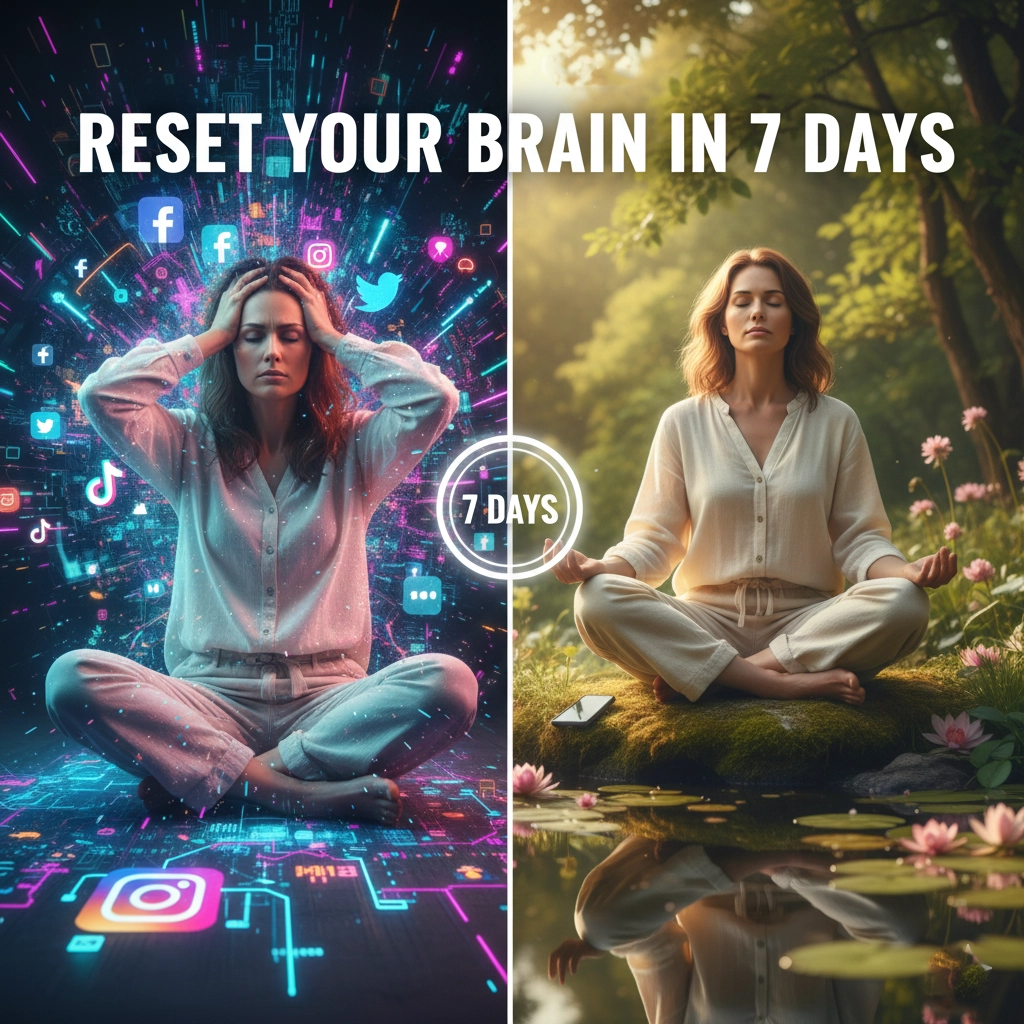
You can't focus for more than 10 minutes. Your brain feels fried by noon. Every notification pulls you in, but nothing actually satisfies you. Welcome to digital burnout—the modern epidemic caused by dopamine overstimulation from screens, social media, and endless scrolling[1][2][3].
This 7-day dopamine detox challenge isn't about staring at walls or punishing yourself. It's a strategic reset to restore your brain's reward system, rebuild your attention span, and help you feel alive again[4][5]. Here's exactly how to do it, what to expect, and why it actually works.
Understanding Digital Burnout (And Why Your Brain Feels Broken)
Digital burnout isn't just tiredness. It's dopamine dysregulation—your brain's reward system becoming desensitized from constant overstimulation[2][3][6].
How Screen Time Hijacks Your Dopamine System
The dopamine problem: Dopamine isn't about pleasure—it's about seeking[7]. Social media, video games, and endless scrolling trigger rapid dopamine release that keeps you coming back for more[2][8].
Brain scan evidence: Gaming releases so much dopamine that on brain scans, it looks identical to cocaine use[9]. Your brain adapts by becoming less sensitive, requiring more stimulation to feel anything[2][9][10].
The Delta FosB protein: Repeated exposure to intense dopamine triggers causes accumulation of Delta FosB in your brain's reward centers[11]. This protein literally changes your brain chemistry, making everyday activities feel boring and unrewarding[11].
Result: You can't enjoy normal things anymore. Reading feels impossible. Conversations bore you. Work tasks feel unbearable. You need constant stimulation just to feel normal[2][11][12].
Signs You're Experiencing Dopamine Burnout
Mental symptoms:
- Inability to focus for longer than a few minutes[13][14]
- Procrastination on important tasks[15]
- Decision fatigue and mental fog[2][16]
- Constant urge to check phone (even when nothing's there)[7][17]
- Loss of motivation for hobbies you used to enjoy[2][12]
Physical symptoms:
- Chronic fatigue despite adequate sleep[15][18]
- Headaches and muscle tension[15][19]
- Disrupted sleep patterns (can't fall asleep or stay asleep)[9][20]
- Restlessness and inability to sit still[21]
Emotional symptoms:
- Mood swings and irritability[21][22]
- Low distress tolerance (small frustrations feel overwhelming)[21][23]
- Anxiety when separated from devices[2][24]
- Feeling emotionally numb or disconnected[2][12]
Time distortion: Hours disappear into screens without awareness, yet time moves slowly when doing anything offline[25].
The Science: Does "Dopamine Detox" Actually Work?
The honest truth: The term "dopamine detox" is scientifically inaccurate[26][27][28]. You can't actually "detox" from dopamine (your brain produces it naturally and needs it to function)[26][27].
What actually happens: You're not depleting dopamine. You're resensitizing your brain's reward receptors by removing overstimulating activities[4][5][26].
Evidence that it works:
Research on fasting shows that temporary abstinence from rewards increases dopamine receptor sensitivity[29][30]. When you remove hyper-stimulating activities, your brain adapts by becoming more responsive to normal, everyday rewards[4][11].
Real-world results: A 30-day challenge study showed participants reduced screen time from 7 hours to 2 hours daily, reclaimed 42 hours weekly, and reported significant improvements in focus, energy, and mood[1].
The mechanism: By avoiding high-dopamine activities (social media, gaming, junk food), you force your brain to find reward in lower-stimulation activities like reading, conversation, or nature[4][5][31]. This rebuilds your baseline dopamine sensitivity[11][31].
Expert consensus: While "dopamine detox" is a misnomer, the practice of reducing overstimulating activities has real benefits—reduced impulsivity, improved focus, better emotional regulation[32][33][34].
The 7-Day Dopamine Detox Challenge (Step-by-Step Plan)
This challenge progressively builds your tolerance for boredom and retrains your brain to find reward in slower-paced activities[4][5].
Pre-Challenge Prep (Day 0)
1. Audit your dopamine triggers
- Track screen time for one day (use built-in phone tracker)[1][35]
- Log every time you reach for phone, what triggered it, and what you did[36]
- Identify your top 3 most addictive activities[4][36]
2. Set up barriers
- Delete social media apps from phone (keep logged in on desktop only)[1][35]
- Turn off all non-essential notifications[35][37]
- Enable grayscale mode on phone (makes screen less stimulating)[1][35]
- Set up app blockers with time limits[1][35]
3. Prepare replacement activities
- Have physical books ready[1][38]
- Plan outdoor activities (walks, nature time)[38][39]
- Prepare creative projects (journaling, drawing, building)[39]
- Schedule face-to-face social time[39]
Day 1-2: Foundation Reset
Rules:
- No social media (Instagram, TikTok, Twitter, Reddit)[4][40]
- No YouTube or streaming video (except pre-selected educational content)[4][40]
- No video games[4][40]
- No junk food or refined sugar[40][41]
- Phone downtime: morning (first 90 mins after waking) and evening (90 mins before bed)[1][35]
- Allow 25 social media "unblocks" per day (5 minutes each)[1]
- Target: 120 phone pickups or less[1]
What to do instead:
- Read physical books or Kindle for 30+ minutes[1][38]
- Take 2-mile walk without earbuds or phone[1][39]
- Journal: "What does boredom feel like? What am I trying to escape?"[36][42]
- Practice sitting with discomfort (don't immediately reach for stimulation)[42]
Expected challenges: Strong urges to check phone. Restlessness. Feeling bored and anxious[1][43]. This is normal—your brain is adjusting[2][11].
Day 3-4: Deepening the Reset
New rules:
- Reduce to 20 social media unblocks per day[1]
- Target: 100 phone pickups or less[1]
- Continue morning/evening phone downtime[1][35]
- Add: No music with lyrics (instrumental only, or silence)[44]
- Add: No caffeine after 12pm[40][45]
What to do instead:
- Practice "intentional boredom"—sit and do nothing for 10 minutes[33][42]
- Creative time: write, draw, build something with your hands[1][39]
- Call family or friends (voice call, not text)[1][39]
- Cook a meal from scratch[39]
Track: Log urges in notebook—what triggered them, what you did instead[36].
Expected progress: Urges slightly reduced. You might notice creative ideas emerging during boredom[1][33].
Day 5-6: The Breaking Point
New rules:
- Reduce to 10 social media unblocks per day[1]
- Target: 75 phone pickups or less[1]
- Add: 6-hour "dopamine fast"—no high-stimulation activities at all[36][40]
- Enable automatic grayscale at sunset[1]
The 6-hour dopamine fast (choose your window):
- No phone, computer, TV, music[40]
- No snacking or caffeine[40]
- Only allowed: reading, writing, walking, thinking, talking face-to-face[40]
What to expect: This is often the hardest day. You'll feel strong resistance[1][43]. Your brain is fighting the change[2][11]. Push through—this is where real neuroplasticity happens[5][46].
Journal prompt: "What emotions am I avoiding by staying distracted?"[36][42]
Day 7: Integration & Assessment
Final day rules:
- Reduce to 5 social media unblocks per day[1]
- Target: 50 phone pickups or less[1]
- Morning and evening phone downtime (no unblocking permitted)[1]
- Grayscale all day[1]
Reflection questions:
- What did I learn about my relationship with technology?[36]
- Which activities actually brought me joy this week?[36]
- What habits will I keep going forward?[36]
- How do I feel compared to Day 0?[1]
Expected results after 7 days:
- Screen time reduced 30-60%[1]
- Improved ability to focus on single tasks[1][33]
- Reduced anxiety and restlessness[4][33]
- Better sleep quality[20][47]
- More present in conversations[39]
- Creative ideas emerging naturally[1][33]
What to Expect: The Real Timeline
Days 1-2: The Withdrawal Phase
Restlessness, anxiety, constant urges to check phone[1][43]. You'll feel bored and uncomfortable[2][42]. This is your brain craving the dopamine hits it's used to[2][11].
Days 3-4: The Adjustment Phase
Urges slightly decrease but frustration peaks[1]. Tasks feel tedious. You'll question if it's worth it[43]. (It is—keep going.)
Days 5-6: The Breaking Point
Either you quit or you break through[1][43]. If you push through, you'll notice mental clarity emerging[1][33]. Creative thoughts start appearing[1][33].
Day 7: The Shift
You feel more present, focused, and in control[1][4]. Normal activities start feeling rewarding again[4][11][31].
Weeks 2-4 (if you continue):
Screen time drops 60-70%[1]. Significant improvements in focus, productivity, relationships, and mood[1][33][39].
Common Challenges (And How to Handle Them)
Challenge 1: "I'm so bored I can't stand it"
Solution: Boredom is the goal[33][42]. It's in those moments of boredom that your brain starts becoming creative again[1][33]. Sit with it. Don't immediately fill the void[42].
Challenge 2: "Work requires me to be online"
Solution: This challenge targets recreational screen time[35]. Use work devices only for work. Block social media, YouTube, news sites during work hours[35].
Challenge 3: "I relapsed and scrolled for 2 hours"
Solution: Don't quit. One slip doesn't erase progress[48]. Log what triggered the relapse[36]. Implement stronger barriers (delete apps, not just log out)[1][35].
Challenge 4: "My family/friends think I'm being extreme"
Solution: Explain it's temporary[48]. Invite them to join you[39]. Use the time to connect face-to-face instead[39].
Challenge 5: "I feel anxious without my phone"
Solution: That anxiety is the addiction talking[2][24]. Use the 5-second rule: count 5-4-3-2-1, then start a different activity[16]. The anxiety passes within minutes[43].
Post-Detox: Making Changes Stick
The real work begins after Day 7. Without sustainable habits, you'll slide back into old patterns[31][48].
Strategies for Long-Term Success
1. Keep Week 4 limits permanently
Maintain 5 social media unblocks daily, 50 phone pickups, morning/evening downtime[1][35]. This prevents relapse[1].
2. Create tech-free zones
Bedrooms, dining rooms, and bathrooms are device-free[35][37]. Charge phone outside bedroom[20][47].
3. Implement the "replacement, not removal" rule
Don't just delete activities—replace them with rewarding alternatives[38][39]. Reading instead of scrolling. Walking instead of gaming[1][39].
4. Monthly weekend resets
One weekend per month, do an intensive reset—minimal tech, maximum nature[48][49].
5. Use the "5-second rule" for urges
When urge hits, count 5-4-3-2-1, then start a different activity[16]. Activates executive function, overrides impulse[16].
6. Batch similar tasks
Check email/messages at set times (not constantly)[16]. Reduces context-switching and mental fatigue[16].
Sustainable Digital Boundaries
Keep permanently:
- Grayscale mode on phone[1][35]
- All notifications off except calls/texts from favorites[35][37]
- Social media only on desktop (not mobile)[1][35]
- No screens first 90 minutes after waking[1][35]
- No screens 90 minutes before bed[20][47]
- One tech-free day weekly[48][49]
Phase back in carefully:
- Limit caffeine to afternoons only[40][45]
- Limit TV/streaming to weekends[40]
- Social media: 15 minutes daily maximum[1][35]
Common Questions About Dopamine Detox
Q: Can I really not listen to music for a week?
A: Instrumental music is fine[44]. The goal is reducing overstimulation, not punishing yourself[4][40]. Music with lyrics can be distracting and dopamine-triggering[44].
Q: Will this cure my ADHD/anxiety/depression?
A: No[27][50]. This addresses lifestyle-induced dopamine dysregulation, not clinical disorders[27]. If symptoms persist after reset, see a healthcare professional[50].
Q: Is 7 days enough to see results?
A: You'll notice improvements in 7 days, but lasting change requires 21-30 days[1][31]. The 7-day challenge is a jumpstart[4].
Q: Can I do this if I work a digital job?
A: Yes[35]. Target recreational screen time, not work[35]. Use website blockers to prevent work-device distraction[35].
Q: What if I fail?
A: Most people slip up[1][48]. The difference between success and failure is whether you restart or quit[48]. Learn from slips, adjust barriers, keep going[1][36].
The Real Benefits (Beyond Just "Less Screen Time")
Improved focus and attention: Ability to concentrate on single tasks for extended periods returns[1][33][51]. Deep work becomes possible again[33].
Emotional regulation: Reduced mood swings, better stress tolerance, improved impulse control[21][32][33].
Better sleep quality: Fall asleep faster, stay asleep longer, wake feeling rested[20][47].
Enhanced creativity: Ideas emerge during moments of quiet[1][33]. Problem-solving improves[33].
Deeper relationships: More present in conversations, better listening, stronger connections[39][52].
Increased productivity: Tasks completed faster with fewer distractions[1][33][51].
Joy in simple things: Reading, nature, conversations become genuinely enjoyable again[4][11][31].
Your Next Move
Digital burnout won't fix itself. Your brain's reward system is hijacked by algorithms designed to keep you scrolling[2][7]. The longer you wait, the harder the reset becomes[2][11].
Start tomorrow:
1. Tonight: Delete social media apps. Enable grayscale. Set morning/evening downtime[1][35].
2. Tomorrow morning: Don't touch phone for first 90 minutes. Read instead[1][35].
3. Track your progress: Log screen time, phone pickups, urges[1][36].
4. Replace, don't just remove: Have books, outdoor activities, creative projects ready[38][39].
5. Commit to all 7 days: The magic happens when you push through discomfort[1][43].
In 7 days, you can reclaim your focus, your creativity, and your time. Or you can keep scrolling, feeling increasingly numb and distracted[2][12].
The choice is yours. But if you're reading this, you already know which path you need to take.