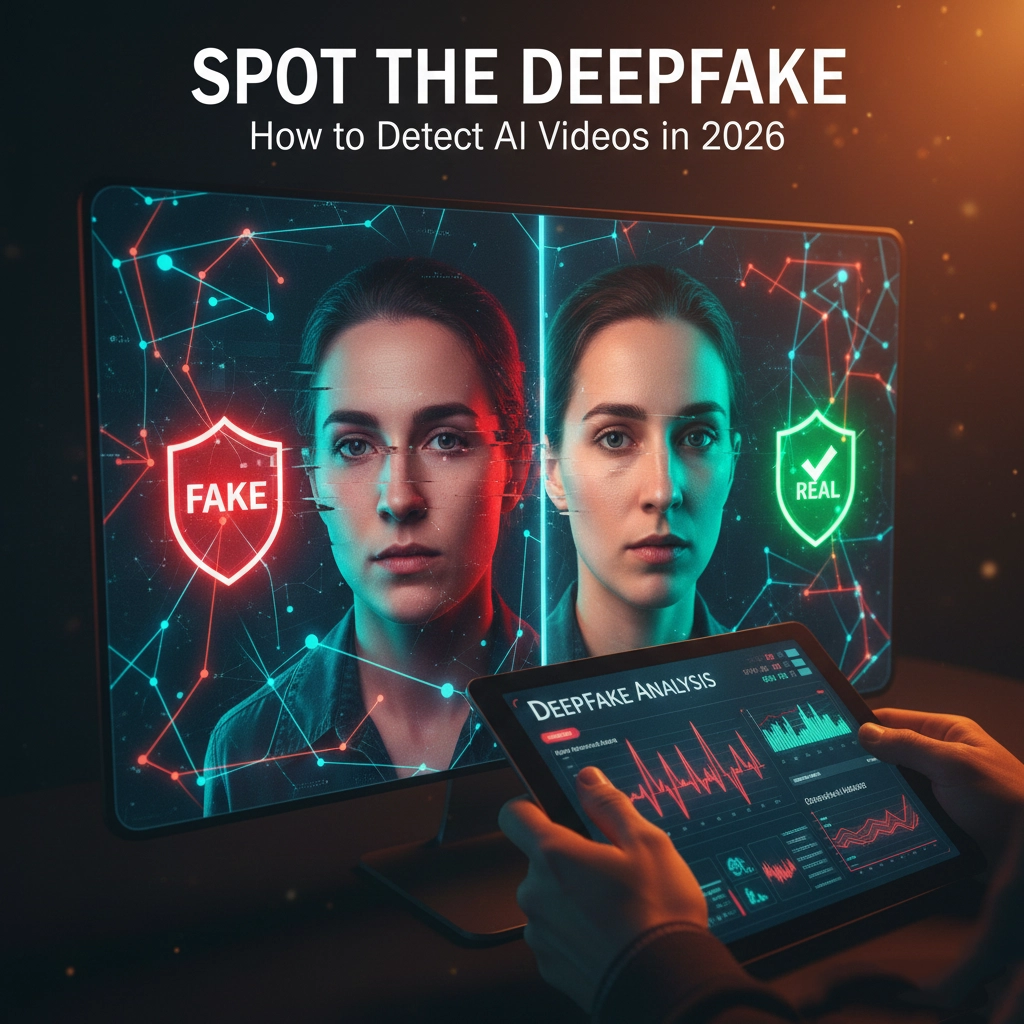
Deepfakes aren't science fiction anymore. They're showing up in your inbox, your news feed, and your video calls. The technology that once required labs and expensive equipment now runs on consumer GPUs, creating videos so realistic that even experts struggle to spot them. By 2025, deepfake incidents increased 19% compared to all of 2024[1], and 46% of all deepfakes are now video-based[2].
This guide cuts through the hype. You'll learn exactly how to spot fake videos manually, which detection tools actually work in 2026, and how to protect yourself before deepfakes cost you money, reputation, or security.
How Deepfakes Actually Work (The Quick Version)
Deepfakes use generative adversarial networks (GANs)—two AI systems fighting each other[3][4]. One creates fake content. The other tries to detect it. They keep battling until the fakes become indistinguishable from reality[3][4].
What happens:
- System collects training data (photos, videos, voice recordings)[4]
- AI learns facial movements, expressions, voice patterns[4]
- Generator creates synthetic content matching the target[3][4]
- Discriminator checks if it looks real (repeats until perfect)[3][4]
Real-world impact: 68% of deepfake content in 2025 was nearly indistinguishable from genuine media[5]. The technology improved so fast that detection tools can't keep up[1][2].
Who's targeted: Financial services (28%), healthcare (19%), government (17%)[2]. But individuals are increasingly targeted for fraud, extortion, and reputation damage[2][6].
Manual Detection: How to Spot Deepfakes With Your Eyes
You don't need AI tools to catch most deepfakes. Your brain is surprisingly good at detecting subtle inconsistencies—if you know what to look for[7][8].
1. Watch the Eyes Closely
Inconsistent blinking patterns: AI struggles with realistic eye blinking[7][8]. Real humans blink 15-20 times per minute. Deepfakes either blink too little, too much, or with unnatural timing[7][8][9].
Pupil dilation: Pupils naturally dilate in low light and contract in brightness[7]. Deepfake pupils often stay fixed diameter regardless of lighting[7]. Watch for eyes that look "off"[7].
Unnatural eye movement: Real eyes make micro-adjustments constantly. Deepfake eyes sometimes move too smoothly or freeze momentarily[7][8][9].
2. Study Facial Expressions
The uncanny valley effect: Your brain generates a negative emotional response when something looks almost-but-not-quite human[7]. Trust that feeling[7].
Micro-expressions: Real faces show fleeting emotions (anger, disgust, surprise) lasting 1/25th of a second[8][9]. Deepfakes miss these or display them unnaturally[9].
Perfect facial symmetry: Real human faces are asymmetrical. Deepfakes sometimes create too-perfect symmetry that looks artificial[8][9].
3. Check Lip-Sync Accuracy
Audio-video mismatch: Deepfake audio often doesn't perfectly sync with mouth movements[7][8]. Look for lag or words that don't match lip shapes[7][8].
Artificial audio noise: Listen for background static, unnatural pauses, or "artifacting" (digital glitches in audio)[7][10]. Real recordings have consistent ambient sound[7].
Flatter tone: AI-generated voices often lack emotional range and conversational flow[10][11]. They sound rehearsed or robotic[10][11].
4. Examine Hands and Body Movement
Hand distortions: AI notoriously struggles with hands[9][12]. Watch for extra fingers, morphing digits, impossible angles, or hands that blend together[9][12].
Unnatural gestures: Hand movements that don't match speech patterns or seem stiff and robotic[9][12].
Body physics violations: Objects passing through each other, clothing defying gravity, or movements that violate basic physics[9][12].
5. Analyze Background Consistency
Background glitches: While AI backgrounds have improved dramatically, check for objects that morph, disappear, or shift unnaturally between frames[7][12].
Lighting inconsistencies: Shadows that don't match light sources, or subject lighting that doesn't match the environment[7][12].
Edge blurriness: Blurry or inconsistent edges around the subject, especially near hair or face boundaries[10][12].
Realistic detection rate (manual): With training, humans can spot 60-70% of deepfakes[7][8]. But that success rate drops as technology improves[1][5].
AI Detection Tools: Which Ones Actually Work in 2026
Manual detection hits a ceiling. Sophisticated deepfakes require AI-powered tools. Here are the ones that actually deliver results:
Bio-ID (98% Accuracy - Commercial)
Performance: Peer-reviewed study showed 98% detection accuracy[13]. Highest accuracy among all tools tested[13].
How it works: Analyzes biological signals invisible to human eyes—blood flow patterns in facial capillaries, micro-movements, physiological signals[14][15].
Best for: Enterprise security, identity verification, KYC processes[15].
Cost: Commercial licensing (contact for pricing).
Deepware Scanner (93% Accuracy - Freemium)
Performance: 93.47% detection rate in independent testing[13]. Best freemium option available[13].
How it works: Web interface and API. Upload video, receive probability score of authenticity[13][16].
Best for: Individuals, small businesses, journalists verifying content[16].
Cost: Free tier available. Premium features require subscription[16].
Intel FakeCatcher (96% Accuracy - Enterprise)
Performance: 96% accuracy in controlled conditions, 91% on "wild" deepfakes[14]. Processes 72 real-time detection streams simultaneously[14].
How it works: Runs on Intel Xeon processors. Analyzes blood flow in facial capillaries (PPG signals), eye movement patterns[14][15].
Best for: Media companies, law enforcement, large-scale content verification[14].
Cost: Enterprise licensing required[14].
Sensity AI (95-98% Accuracy - Enterprise)
Performance: 95-98% accuracy across video, images, audio, and text[17]. Monitors 9,000+ sources continuously[17].
How it works: Multimodal detection—face swaps, manipulated audio, AI-generated images, synthetic text[17]. Integrated SDK for KYC/identity verification[17].
Best for: Businesses, government agencies, cybersecurity firms[17].
Cost: Commercial (contact for quote)[17].
Reality Defender (Multi-Model Platform)
Performance: Uses probabilistic detection across multiple AI models[18]. Doesn't rely on watermarks or prior authentication[18].
How it works: Analyzes video, images, audio, and text. Combines multiple detection algorithms for higher accuracy[18].
Best for: Organizations needing comprehensive deepfake protection[18].
Cost: Enterprise pricing[18].
Pindrop Pulse (Audio Deepfakes - 99% Accuracy)
Performance: Identifies synthetic voices in 2 seconds with 99% accuracy[19]. Specialized for audio/voice deepfakes[19].
How it works: Analyzes voice patterns, tonal shifts, timing anomalies, background static[19][20].
Best for: Call centers, media organizations, government agencies verifying voice authenticity[19].
Cost: Commercial licensing[19].
DeepFake-o-meter (Research Tool - Free)
Performance: Combines multiple detection algorithms. Provides probability output of authenticity[21].
How it works: Frame-by-frame analysis. Distinguishes successful vs unsuccessful screen captures[21]. Tests video against multiple detection models[21].
Best for: Researchers, academics, individuals testing content[21].
Cost: Free (research purposes)[21].
Resemble AI DETECT-2B (Real-Time Audio)
Performance: Real-time audio deepfake detection with multilingual support[22].
How it works: Embeds authenticity verification directly into communications workflows[22].
Best for: Enterprises needing real-time voice verification[22].
Cost: Commercial (API pricing)[22].
The Reality Check: What Detection Tools Can't Do
Problem 1: Different tools give conflicting results
The same video tested across 6 detection algorithms gave wildly different scores—some 90%+ fake probability, others 0.5-18.7%[23]. No single tool is perfect[23].
Problem 2: New deepfakes bypass old detectors
Tools trained on older datasets struggle with new techniques[1][5]. OpenAI's detector catches DALL-E 3 images at 98.8% but only 5-10% from other tools[24].
Problem 3: Voice cloning is outpacing video detection
Voice deepfakes now require only 30-90 seconds of audio to clone someone perfectly[20]. Emotion-aware, multilingual models are harder to detect[20].
Problem 4: Hyperrealism is winning
2025 deepfakes are photorealistic enough that 68% are indistinguishable from real media[5]. Detection accuracy is dropping as creation quality rises[1][5].
Reality: Combine multiple tools + human judgment. No single solution catches everything[23].
Real-World Deepfake Threats in 2026
Financial Fraud (28% of All Incidents)
Executive impersonation: Deepfake video calls from "CEO" requesting wire transfers[2][6]. One company lost $25 million from a single deepfake video call[2].
Voice phishing: AI-cloned voices of family members requesting emergency money[20][25]. Attackers need 30 seconds of audio from social media[20].
Identity Theft & Account Takeover
Fake KYC verification: Deepfake videos passing liveness checks for account creation[17][25]. Used to open bank accounts, credit cards, crypto wallets[25].
Social engineering: Personalized phishing using deepfake video messages[2][6]. 35% of cyber incidents by end of 2025 involve deepfake elements[5].
Reputation Damage
Fake statements: Politicians, executives, celebrities appearing to say things they never said[1][6]. Difficult to disprove once viral[6].
Synthetic media manipulation: Altered videos used for blackmail, extortion, defamation[2][6].
Financial impact: $1.2 billion in losses globally from deepfake-related incidents in 2024 alone[5]. Detection market projected to reach $3.5 billion by end of 2025[5].
Your Protection Strategy: What Actually Works
For Individuals
1. Verify unexpected requests – If someone (boss, family, friend) contacts you with unusual request via video/voice, verify through separate channel[20][25].
2. Use verification codes – Establish code words with family for emergency calls[20]. If they can't provide the code, it's fake[20].
3. Slow down suspicious content – Freeze frames, watch at 0.25x speed to spot inconsistencies[9][12].
4. Check multiple sources – If news seems shocking, verify across multiple trusted outlets before sharing[6].
5. Test with free tools – Use Deepware Scanner or DeepFake-o-meter to verify suspicious videos[13][21].
For Businesses
1. Implement multi-factor authentication – Voice/video alone isn't enough. Require secondary verification for high-risk actions[17][25].
2. Deploy detection tools – Sensity AI, Reality Defender, or FakeCatcher for continuous monitoring[14][17][18].
3. Train employees – Regular deepfake awareness training. 60-70% detection success with proper training[7][8].
4. Establish verification protocols – Wire transfers, sensitive data sharing require in-person or multi-channel verification[2][25].
5. Monitor dark web – Track if your executives' voices/faces appear in deepfake databases[2][6].
Common Questions About Deepfake Detection
Q: Can I completely trust detection tools?
A: No. Even 98% accuracy means 2 out of 100 deepfakes slip through[13]. Use multiple tools + human judgment[23].
Q: How quickly is deepfake technology improving?
A: Fast. 19% increase in incidents in just Q1 2025 vs all of 2024[1]. 68% of content is now photorealistic[5].
Q: Are audio deepfakes easier to detect than video?
A: No—actually harder[20]. Voice cloning requires only 30-90 seconds of audio and is outpacing video in sophistication[20].
Q: What if I spot a deepfake?
A: Report it to the platform immediately. Don't share it (even to debunk)[6]. Notify anyone targeted[6].
Q: Can deepfakes be used legally?
A: Yes—entertainment, education, accessibility. But regulations are tightening. Many jurisdictions require labeling AI-generated content[26].
The 2026 Reality
Deepfakes aren't going away. The technology is improving faster than detection tools can adapt[1][5]. But that doesn't mean you're defenseless[7][8].
Your move:
1. Learn manual detection – Eyes, hands, lip-sync, background. 60-70% success rate with practice[7][8].
2. Use free tools first – Deepware Scanner or DeepFake-o-meter for suspicious content[13][21].
3. Verify unexpected requests – Separate channel verification for anything involving money or sensitive data[20][25].
4. Stay skeptical – If content triggers strong emotion (outrage, fear, urgency), slow down and verify[6][9].
5. Businesses: Deploy professional tools – Sensity, Reality Defender, FakeCatcher for continuous protection[14][17][18].
The deepfake arms race is accelerating. Detection tools improve, creation tools improve faster[1][5]. Your best defense isn't technology—it's skepticism combined with verification[7][8][23].
Trust, but verify. Always.