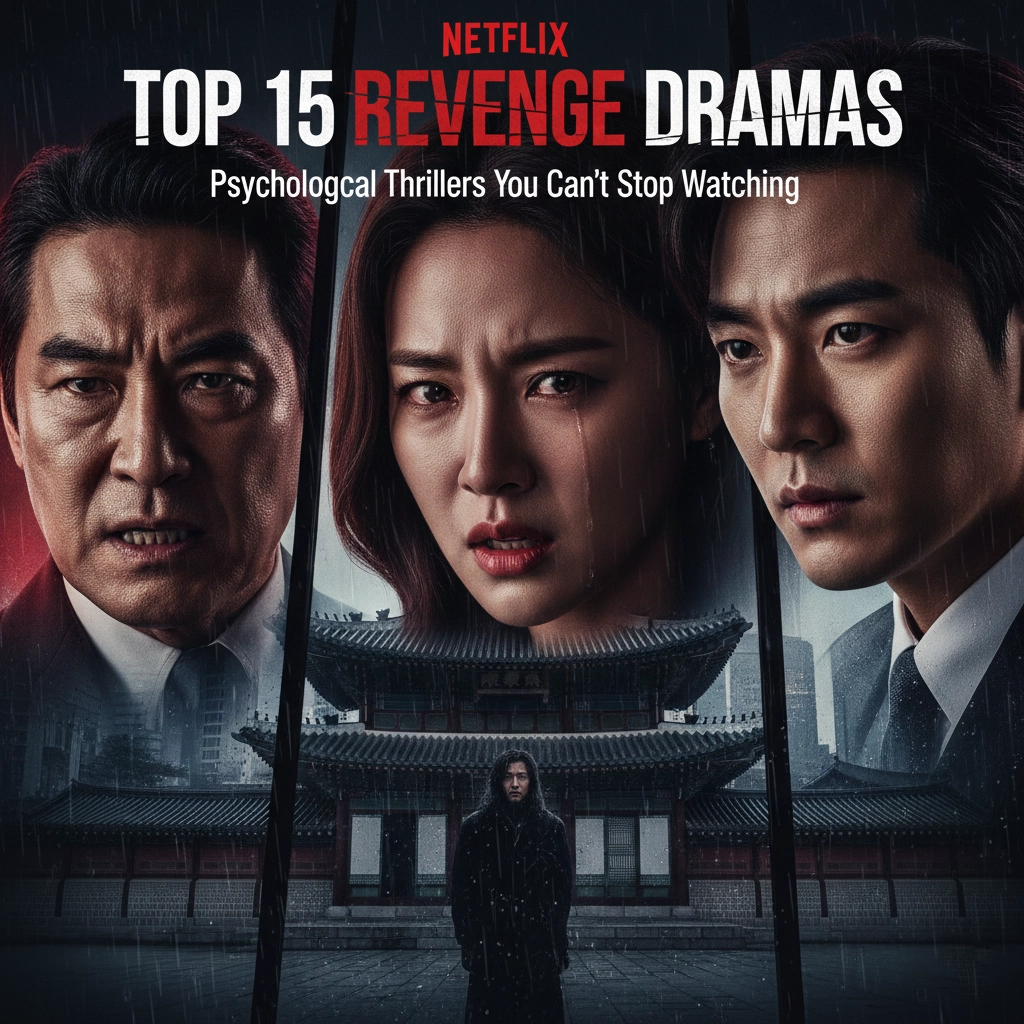
K-dramas have become a global obsession, and 2025 proved that audiences crave darkness. Forget the romantic coffee-shop vibes—the real magic is in revenge plots that simmer for 16 episodes, psychological games that twist your mind, and moral ambiguity that leaves you questioning who the villain actually is[1][2][3].
This guide covers the best Korean revenge K-dramas and dark psychological thrillers you should be watching right now: which ones deliver gut-punching twists, why the chemistry matters, which streaming platforms have them, and whether they're actually worth the time investment.
Why Revenge K-Dramas Exploded in 2025
2025 was the year revenge dramas went mainstream. Netflix, Disney+, and Korean streaming platforms flooded the market with dark thrillers starring A-list actors[1][3][4].
Why audiences are obsessed:
- Moral ambiguity: The "villain" often has legitimate grievances[1][2]
- Slow-burn tension: Payback unfolds over 12-16 episodes, not in a movie montage[3]
- Korean cinematography: Dark lighting, tight framing, exceptional sound design[4][5]
- Psychological depth: Characters are damaged, flawed, human[2][3]
- High stakes: Personal vengeance scales to corporate conspiracies or murder mysteries[1][4]
The shift from 2024 to 2025: Less "I'll seduce him to get revenge" energy. More "I'm literally planning to destroy his entire existence" energy[1][2].
The Best Revenge K-Dramas of 2025 (Ranked by Impact)
1. Study Group (2025) - Most Visceral
Plot: At Yusung Technical High School, Yun Ga-min (Hwang Min-hyun) wants to study his way out of his terrible life. But when bullies threaten his friends, he forms a "study group" that becomes an unlikely shield against violence[5][6]. What starts as academic revenge turns into full-scale war[5][6].
Why it hits hard: Bullying is handled with brutal realism—not melodrama[6]. The violence is consequence-driven, not gratuitous[6]. Ga-min's transformation from victim to strategist happens gradually, making it believable[6].
Performances: Hwang Min-hyun's quiet intensity is devastating. Park Ji-hoon's contrast as the protective friend grounds the chaos[6].
Streaming: Netflix / Wavve[5].
Episodes: 8 (short, punchy, no filler)[5].
Verdict: Best for viewers who want raw, uncomfortable tension. Not "feel-good" revenge—real consequences[6].
2. Buried Hearts (2025) - Most Complex
Plot: A political slush fund worth trillions triggers a deadly chain reaction. After a hacker is killed for accessing secret money, Seo Dong-ju (Park Hyung-sik), a loyal executive with hidden ambition, moves toward his own goals[7]. Meanwhile, Yeom Jang-seon (Huh Joon-ho), a former intelligence chief turned elite professor, manipulates the political world from the shadows[7].
Why it's brilliant: There's no clear protagonist[7]. Both men are using everyone around them. Loyalty is a weapon, not a virtue[7]. The corporate/political intrigue is dense but never boring[7].
Performances: Park Hyung-sik's calculated restraint vs Huh Joon-ho's intellectual menace—electric[7].
Streaming: Disney+, Hulu, Wavve[7].
Episodes: 16 (long enough to develop intricate plots)[7].
Verdict: Best for viewers who love puzzle-box narratives. Requires attention but pays off[7].
3. Mercy For None (2025) - Most Noir
Plot: Nam Gi-jun (So Ji-sub), once a feared fighter in the Bongsan Gang, walked away from crime to protect his younger brother. Years later, he runs a quiet drink supply business. Then his brother is found dead under suspicious circumstances, and Gi-jun is forced back into darkness[8]. Old enemies, gang territories, and hidden truths collide[8].
Why it works: Crime underworld drama with genuine emotional stakes[8]. Gi-jun isn't seeking revenge for honor—he's seeking answers about his brother's death[8]. The moral weight feels real[8].
Performances: So Ji-sub brings weathered exhaustion to a man trying to escape his past[8].
Streaming: Disney+[8].
Episodes: 12[8].
Verdict: Best for neo-noir fans. Gritty, atmospheric, no heroes[8].
4. Unbound (2025) - Most Psychological
Plot: Ah-jin (Kim Yoo-jung) rises from trauma to exact revenge with Kim Jae-oh (Kim Do-hoon) circling and Lee Yul-eum tied to her trauma[9]. Her psychological journey turns the revenge plot into a moral battlefield where motivation becomes questionable[9].
Why it's haunting: The drama doesn't excuse Ah-jin's cruelty just because she suffered[9]. Her revenge damages everyone around her, including those trying to help[9]. It's a raw exploration of how trauma can corrupt[9].
Performances: Kim Yoo-jung's unraveling is genuinely unsettling. Her emotional complexity beats typical "wronged woman" tropes[9].
Streaming: TVING, HBO Max, Viki[9].
Episodes: 12[9].
Verdict: Best for viewers who want to feel uncomfortable. Phenomenal acting, dark themes[9].
5. The Last Payback (2025) - Most Intense
Plot: Tae-jung (Ji Chang-wook) loses his entire life to a man who frames him for a crime he didn't commit. After prison, with the help of his only ally, No Yong-sik (Kim Jong-soo), a prison mentor, Tae-jung plans the ultimate payback[10]. The execution is methodical and devastating[10].
Why it crushes: Ji Chang-wook at his absolute best—desperate, intelligent, willing to destroy himself to destroy his enemy[10]. The plan unfolds over 12 episodes with zero wasted moments[10].
Performances: Ji Chang-wook is born for this role. Do Kyung-soo's comic relief timing prevents it from becoming unbearably dark[10].
Streaming: Disney+[10].
Episodes: 12[10].
Verdict: Best for viewers who want pure, concentrated revenge. Tense from episode 1[10].
The Classics (That Still Hit Harder Than 2025 Releases)
Flower of Evil (2020) - Masterpiece Tier
Plot: Baek Hee-Sung (Lee Joon-gi) appears to be a perfect husband and father. But hidden behind his facade lies a dark secret: he may be connected to unsolved murders. His wife, Cha Ji-Won (Moon Chae-won), a detective, begins to suspect him[11].
Why it's genius: Psychological thriller + romance + family drama, perfectly balanced[11]. The twist lands hard because you're invested in their relationship[11]. Hee-Sung's character is one of the best-written anti-heroes in K-drama history[11].
Streaming: Viki, Netflix (region-dependent)[11].
Episodes: 16[11].
Verdict: Top 3 K-dramas ever made. If you watch one recommendation from this list, make it this[11].
Beyond Evil (2021) - Most Gripping Crime Drama
Plot: Two detectives—Lee Dong Sik (Shin Ha Kyun) and Han Joo Won (Yeo Jin Goo)—investigate a serial killer in a small town[12]. But the real mystery isn't who the killer is—it's whether either detective can be trusted[12].
Why it matters: Redefines the detective thriller genre[12]. The chemistry between the leads is magnetic[12]. Every episode reveals new information that recontextualizes previous scenes[12].
Streaming: Viki, Netflix (region-dependent)[12].
Episodes: 16[12].
Verdict: Best psychological crime thriller ever made. Binge-worthy[12].
Itaewon Class (2020) - The Blueprint
Plot: Park Sae Ro Yi (Park Seo-joon) is an ex-con who lost everything—his father, freedom, future—to a powerful family[13]. After prison, he returns to Itaewon to systematically destroy the family that destroyed him[13].
Why it's iconic: The blueprint for modern revenge dramas[13]. Perfect pacing, unforgettable characters, genuine stakes[13]. Sae Ro Yi's journey from victim to predator is heartbreaking and thrilling[13].
Streaming: Netflix[13].
Episodes: 16[13].
Verdict: If you've never watched revenge K-dramas, start here[13].
Dark Psychological Thrillers (Non-Revenge)
Stranger (2017-2018) - Best Detective Thriller
Plot: A prosecutor who lacks emotions (Cho Seung-woo) teams up with a detective (Bae Doona) to investigate murder cases involving a powerful conglomerate[14]. What unfolds is corruption so deep it implicates the government itself[14].
Why it's essential: Prestige television level writing[14]. Corruption is portrayed realistically—not as a simple crime, but as systemic rot[14]. Two seasons, both exceptional[14].
Streaming: Netflix[14].
Episodes: 16 (season 1) + 16 (season 2)[14].
Verdict: Best thriller if you prefer mystery over revenge[14].
Strangers from Hell (2019) - Most Claustrophobic
Plot: Yoon Jong Woo (Im Si Wan), a young man new to Seoul, moves into a cheap dormitory called Eden Studio to afford housing[15]. But the residents are nightmare fuel—predatory, deranged, dangerous[15]. Trapped with no money to leave, he fights for survival[15].
Why it disturbs: Isolation and paranoia are weaponized[15]. You never know who's a threat until it's too late[15]. The atmosphere is oppressive—watching it feels like drowning[15].
Streaming: Netflix[15].
Episodes: 10[15].
Verdict: Best psychological thriller about survival. Not a "revenge" story—it's horror[15].
Taxi Driver (2021-2022) - Best Action-Thriller
Plot: A group runs a secret "revenge taxi service" where they help victims get justice against their tormentors[16]. Each episode is a different victim, different revenge plan[16]. But the team has their own dark secrets[16].
Why it works: Perfect episodic structure without sacrificing character development[16]. The action sequences are Korean-cinema quality[16]. Lee Je-hoon's dead-inside protagonist is compelling[16].
Streaming: Viki, Netflix (region-dependent)[16].
Episodes: 12 (season 1) + 12 (season 2)[16].
Verdict: Best if you want fun + thrills + revenge. Perfect popcorn drama[16].
The 2025 Honorable Mentions
Confessions of a Murder Suspect (2025): A girl grows up to lead survivors exposing a cult leader's crimes[17]. Dark, focused, 8 episodes[17].
Dear Hongrang (2025): Jae-i searches for her brother while confronting dark family secrets and Joseon-era dangers[18]. Psychological + historical[18].
How to Choose: Which Drama Is Right For You?
Want pure revenge satisfaction? → Study Group, Itaewon Class, Taxi Driver
Want psychological depth + moral ambiguity? → Buried Hearts, Flower of Evil, Unbound
Want claustrophobic horror? → Strangers from Hell, Mercy For None
Want detective thriller? → Beyond Evil, Stranger, Innocent Defendant
Want dark but entertaining? → Taxi Driver, The Last Payback
Streaming Platform Guide
Netflix: Flower of Evil, Beyond Evil, Itaewon Class, Stranger, Strangers from Hell, Taxi Driver[11][12][13][14][15][16].
Disney+: Buried Hearts, Mercy For None, The Last Payback[7][8][10].
Viki: Beyond Evil, Flower of Evil, Taxi Driver[12][11][16].
TVING/HBO Max: Unbound[9].
Netflix/Wavve: Study Group[5].
Kocowa: White Christmas, Nobody Knows[19][20].
Common Questions About K-Drama Revenge Dramas
Q: Do these all have happy endings?
A: No. Revenge dramas often end with the protagonist destroyed, morally compromised, or dead[1][2][3]. That's the point—revenge costs everything[1].
Q: Are there good guys in these shows?
A: Usually not. Everyone is complicit, flawed, or damaged[2][3][4]. The "hero" is often the least sympathetic character by the end[2].
Q: Do I need to understand Korean culture to enjoy them?
A: No. The psychological dynamics and emotional stakes are universal[1][3]. K-drama excellence is in storytelling, not cultural specificity[3].
Q: How dark do they get?
A: Most stay within "prestige drama" darkness. Some (Strangers from Hell, Mercy For None) are genuinely disturbing[15][8]. Check warnings if you're sensitive to violence or abuse[4][5].
Q: How long does each episode take?
A: Typically 50-60 minutes. Most dramas are 12-16 episodes[1][2][3]. Total commitment: 10-16 hours per drama[1].
The Verdict: Why 2025 Was the Year of Revenge K-Dramas
2025 proved that audiences are tired of simple narratives. We want morally complex characters, slow-burn tension, and endings that haunt us[1][2][3]. K-dramas deliver all of this better than Western television[4][5].
If you watch nothing else this year, watch:
- Flower of Evil (if you want a masterpiece)[11]
- Study Group (if you want 2025's best new show)[5]
- Itaewon Class (if you're new to revenge dramas)[13]
- Buried Hearts (if you want corporate intrigue)[7]
The K-drama industry isn't slowing down. 2026 will bring new revenge plots, darker psychological games, and performances that redefine the genre[1][3]. The revolution is now[2].
Stop watching what you think you should watch. Start watching what genuinely disturbs and compels you. Revenge K-dramas deliver both[1][2][3].